Conemaugh Roofing Co.

Roofing

Roof Ventilation in Johnstown, PA

Balanced roof ventilation prevents ice dams and protects homes through Johnstown winters.

  • ✓Mon-Fri 9am-9pm
  • ✓Roof Replacement & Repair
  • ✓Johnstown, Cambria & Northern Somerset Counties

Request a Callback

Tell us about your roof problem and a local technician will call you back.

Johnstown sits in a deep valley where heavy Laurel Highlands snow loads meet steep hillside roofs on steel-mill-era frame houses in neighborhoods like Moxham, Kernville, Westmont and Cambria City. Freeze-thaw cycles and ridge-top winds push snow and ice into eaves and valleys, while limited original attic ventilation allows warm air to melt snow from below and create dams that force water under shingles. Older plank decking and multiple layers of roofing compound the problem because air cannot move freely from soffits to ridge.

Our crews begin every job with an attic inspection that checks existing soffit intake vents, ridge openings, insulation levels and signs of moisture on plank decking. We climb the steep pitches common to these homes and examine chimney flashing, valleys and any flat sections over additions for blocked or missing vents. From the exterior we note wind exposure on ridge lines and confirm whether the home sits on a narrow street lot in Downtown Johnstown or a more open site in Richland Township.

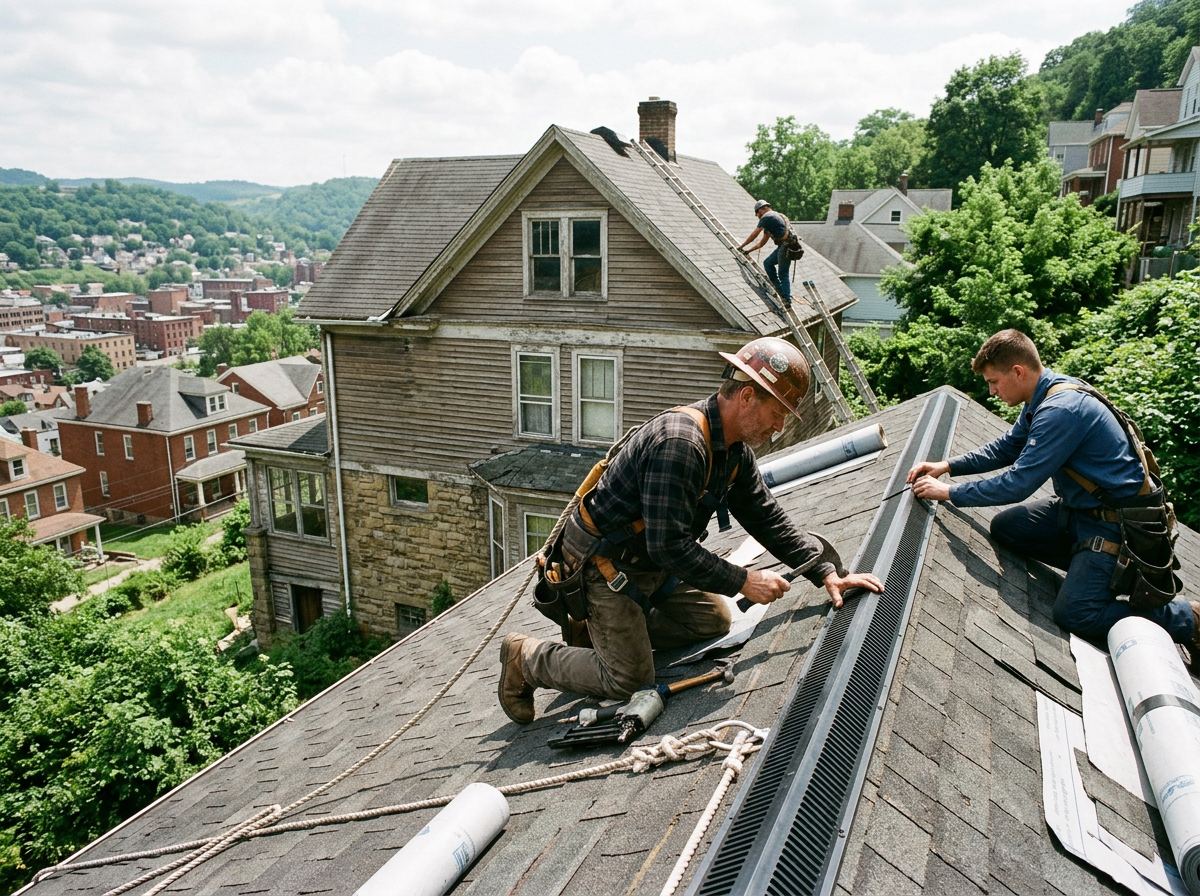
Work focuses on restoring proper airflow by cutting in continuous ridge vents, adding or enlarging soffit intake vents and installing baffles to keep insulation from blocking the path. On homes with plank decking we re-sheet sections with OSB where needed before new underlayment and shingles go down. The goal is balanced intake and exhaust that reduces attic heat buildup and stops ice from forming at the eaves during repeated winter storms.

Technician insight

In Johnstown the thing that catches most people out with roof ventilation is the plank decking on 1900-1940 homes in Moxham and Kernville. Homeowners add a ridge vent but leave the soffits closed or blocked by insulation, so air never moves and ice dams keep forming at the eaves during the first big snow.

Westmont Home Ice Dam Prevention

A steep-pitch slate-to-shingle roof on a narrow Westmont street showed repeated ice dam leaks at the valleys after heavy snow. We found closed soffits and no ridge opening on the plank deck. Our crews added continuous ridge vent, opened soffit intake sections and re-sheeted blocked deck areas so air could flow the full rafter length.

Roof Ventilation Services We Offer

✓Ridge Vent Installation

We cut continuous ridge vents along the peak to release hot air and moisture that otherwise melts snow from below and feeds ice dams on steep Laurel Highlands roofs.

✓Soffit Intake Venting

New or enlarged soffit vents pull cold air in at the eaves so air can travel the full length of the rafters before exiting at the ridge.

✓Attic Ventilation Balance Assessment

We measure existing intake and exhaust openings on older Johnstown homes to identify shortfalls that allow ice dams to form during heavy snow winters.

✓Ice Dam Mitigation Vents

Targeted vent additions at valleys and eaves reduce the temperature differential that causes water to back up under shingles on tight-access hillside lots.

✓Plank Decking Ventilation Upgrades

Where original board decking restricts airflow we re-sheet sections and add vents so air can move freely without trapping moisture against the wood.

How it works

  1. 1

    Attic and Roof Inspection

    We enter the attic and walk the exterior to check current venting, insulation, deck condition and ice-dam locations on the specific pitch and exposure.

  2. 2

    Ventilation Plan

    We calculate required intake and exhaust openings based on roof size, existing layers and the home's location on a sheltered valley lot or windy ridge.

  3. 3

    Installation Work

    Our crews cut ridge vents, enlarge or add soffit vents, install baffles and re-sheet plank decking where airflow is blocked.

  4. 4

    Final Airflow Check

    We verify continuous airflow from soffit to ridge and confirm no new openings were left vulnerable to wind-driven snow.

What's Included in the Visit

Ridge vent installation

Full-length ridge vent cut in along the peak of your roof, sized to your attic square footage. We use shingle-over ridge vent that matches your field shingles so it disappears from the street. This is the exhaust half of the system and the most important single upgrade on most Johnstown homes.

Soffit intake vents

We cut in soffit intake vents along the eaves and clear any insulation blocking them. Intake is the half most contractors skip, and without it a ridge vent pulls almost no air. We baffle around the vents so blown-in insulation stays out of the airway.

Off-ridge and gable vents

Where a hip roof or a short ridge limits ridge vent length, we add off-ridge exhaust vents or reuse existing gable vents in the calculation. We balance them against intake so you do not create a short circuit that pulls air from one vent straight out another.

Moisture and deck check

We take moisture meter readings at multiple points and check for rotted decking, rusted nails, and mold on the underside of the sheathing. Venting a rotten deck just traps the problem.

Flashing and sealing

Every vent penetration gets ice and water shield and new flashing, sealed with roofing felt and drip edge where it meets the field. We re-nail with a roofing nail gun and finish with a utility knife trim. This is what keeps the vent from leaking two winters down the road.

Tools and Methods We Use

Moisture meter

Reads the moisture content of roof decking and sheathing. We take readings before and after every job, and anything above 20 percent tells us the deck is holding water and needs attention before we vent over it.

Shingle ripper

Clean cuts mean the ridge vent sits flat and the shingles lay back down tight.

Roofing nail gun

Fastens ridge vent, flashing, and re-nailed shingles with consistent depth. We set the pressure so nails seat without overdriving through the shingle mat, which is a common cause of blow-offs.

Ladder stabilizer

Keeps ladders off gutters and spreads the load on the roof edge. On steep Westmont and Richland Township roofs, it is what keeps our crew safe and your gutters unbent.

Pitch hoist

Lifts bundles of shingles and vent materials up steep pitches without dragging them across your roof. It protects the shingles below and gets material to the ridge faster.

Magnetic sweeper

Runs across the lawn, driveway, and walkways at the end of every job to pick up stray roofing nails. It is the last thing we do before we leave, and it is why you will not find nails in your tires.

Conemaugh Roofing Co. — roofing in Johnstown

Good to know

Roof Ventilation — FAQs

Still have questions? We're happy to talk it through.

(814) 992-6091
+ How does roof ventilation stop ice dams in Johnstown winters?
Balanced intake at the soffits and exhaust at the ridge keeps attic temperatures closer to outside air so snow does not melt from below and refreeze at the eaves.
+ Can ridge vents be added to older homes with plank decking?
Yes, but sections of plank often need re-sheathing with OSB first so the vent can be fastened securely and sealed against wind-driven snow.
+ Do steep hillside roofs in neighborhoods like Moxham need special venting?
The steep pitches and tight access mean vents must be placed to maintain airflow the full length of the rafters without creating new leak points at valleys or chimneys.
+ Will new soffit vents work on homes with narrow streets and limited overhangs?
We use low-profile soffit vents and baffles sized to the existing overhang so air enters even when the house sits close to the road in older Cambria County neighborhoods.

Business hours — Mon–Fri 9am–9pm

Need Roof Replacement in Johnstown, PA?

Talk to a local roof replacement company serving Johnstown and nearby neighborhoods. We deliver consistent workmanship on roof replacement and roof repair projects throughout Cambria County and the Laurel Highlands.

Call now Request a callback