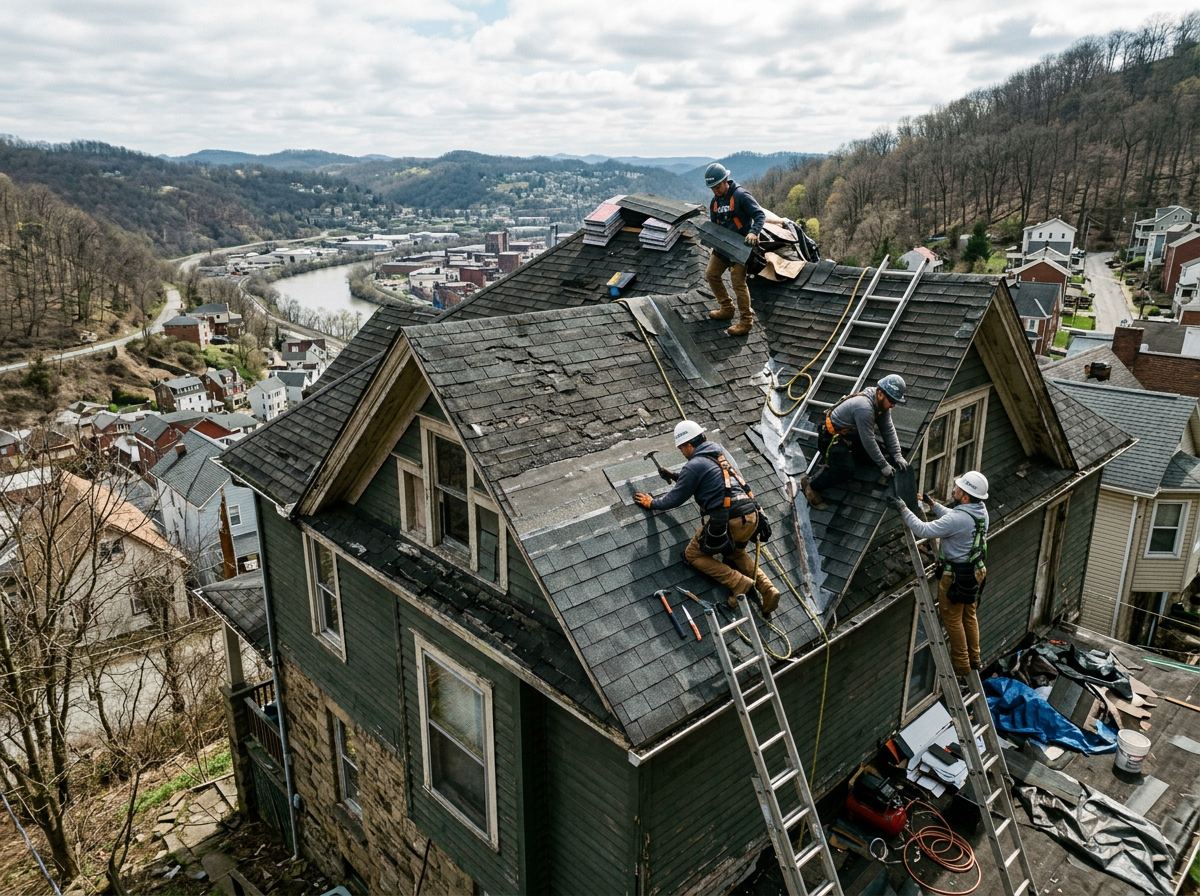
Roof leaks in Johnstown often trace to ice dams that form along eaves during repeated freeze-thaw cycles, failed step flashing around chimneys on 1900-1940 frame houses, or wind-driven rain that lifts shingles on steep pitches. Our crews begin every job with a hands-on attic inspection to trace water stains to their entry points, checking plank decking for rot, examining valleys for granule loss, and testing pipe boots and counter-flashing on brick chimneys. We then remove damaged sections without disturbing sound slate or shingle layers still performing, install fresh ice and water shield at eaves and valleys, and restore proper ventilation balance so warm attic air no longer melts snow unevenly.
Steep hillside lots in neighborhoods like Kernville, Cambria City and Westmont create tight access that limits ladder placement and requires careful staging on narrow streets. Our crews use ridge vents paired with soffit intake to reduce ice dam pressure, replace missing or curled shingles after strong ridge-top winds, and re-flash walls where additions meet the main roof. On homes with multiple layers over plank decking we evaluate whether localized re-sheathing is needed before new underlayment goes down, paying special attention to the valleys that collect heavy spring runoff from the surrounding Laurel Highlands.
After repairs we verify the fix during the next rain event or by controlled hose testing, confirming that water no longer reaches the interior. Because many Johnstown roofs still carry original slate under later shingles, we match repair methods to the existing system rather than forcing a full conversion unless the owner requests it. This approach keeps crews focused on stopping the active leak while preserving as much of the original roof as possible.
Technician insight
In Johnstown the thing that catches most people out with roof leak repair is plank decking that has delaminated under old slate or multiple shingle layers; once water reaches the boards it spreads sideways along the grain and shows up two rooms away from the actual breach, so you have to open more roof than the stain suggests.
Ice Dam Leak on Westmont Hillside Home
Water stains appeared on the second-floor ceiling after a January thaw. We traced the path to an ice dam that had formed above a valley on the steep rear slope. Our crews removed the ice, installed extended ice and water shield, and re-flashed the intersecting roof planes. No further interior leaks occurred through the remaining winter storms.
Roof Leak Repair Services We Offer
✓Ice Dam Leak Repair
Our crews clear ice dams at eaves and valleys then install extended ice and water shield to prevent recurring leaks on steep-pitch Laurel Highlands roofs.
✓Chimney Flashing Repair
We replace deteriorated step flashing and counter-flashing around brick chimneys common on early-1900s homes in Moxham and Kernville.
✓Valley Leak Repair
Technicians reinforce open or damaged valleys with new underlayment and metal flashing sized for the heavy runoff from Johnstown thunderstorms.
✓Wind-Damaged Shingle Repair
Missing or lifted shingles from ridge-top winds are replaced and secured with proper starter strip and ridge vent integration.
✓Slate Slip and Crack Repair
Individual cracked or slipped slate tiles are replaced or re-secured on homes that still carry original slate beneath later layers.
How it works
- 1
Attic and Exterior Inspection
We enter the attic to trace water stains and check plank decking condition before climbing the steep roof to locate the exact breach.
- 2
Targeted Tear-Off and Preparation
Damaged sections are removed only where needed, plank decking is assessed for re-sheathing, and new ice and water shield is applied at eaves and valleys.
- 3
Flashing and Ventilation Restoration
Chimney and wall flashing is renewed, pipe boots replaced, and ridge vent plus soffit intake balanced to reduce future ice dam pressure.
- 4
Final Verification
The repaired area is hose-tested or observed during the next rain to confirm the leak path is fully sealed.